
Honeywell Air Duct Cleaning in Encino: A Homeowner’s Guide
If your Encino home has a Honeywell whole-home air cleaner mounted on the return plenum, a standard duct cleaning that skips servicing that unit first is a lot like mopping a floor around a dirty mop: the source of the mess never moves. Cleaning around Honeywell components without pulling and servicing them leaves contamination sitting in the air path, and the ducts you just cleaned breathe it right back in. This guide covers the Honeywell-specific details that most generic cleaning advice ignores.
Which Honeywell Systems End Up in Encino Homes?
Encino homes run the full range of housing stock, from ranch-style houses off the Ventura Freeway corridor to newer builds up in the hills, and the Honeywell equipment varies with it. The three you’ll run into most often each interact with duct cleaning in a different way.
- Honeywell F300 electronic air cleaner. Sits inline on the return duct and uses charged collector cells to trap particles. The cells are washable, but they load up with a wet, sticky film over time, and that film is exactly what you don’t want redistributed through a system under negative pressure.
- Honeywell HM750A bypass humidifier. Taps into the ductwork with a bypass duct and a water panel. The drain pan and distribution tray stay damp, which is a standing invitation for biological growth right next to your supply air.
- Honeywell TrueFRESH ventilation. Brings outside air into the return, and its filter and duct run collect their own share of dust and pollen. A TrueFRESH unit that never gets serviced just feeds unfiltered outdoor air into a system you thought was clean.
Add the standard F100 media filter cabinet most of these homes also have, and you’ve got several components sitting directly in the duct path. That’s the piece generic guides miss. In our experience, the cleaning sequence matters as much as the cleaning itself.
Why the Cleaning Sequence Matters With an Electronic Air Cleaner
If your home has a Honeywell F300, the collector cells have to come out and get washed before any negative-pressure cleaning starts. That’s the non-negotiable part of this job that most people don’t know to ask about.
Here’s the reasoning. A rotary brush dislodges debris from the duct walls, and a HEPA vacuum captures it under negative pressure. That works beautifully on bare ductwork. But if the electronic cells are still seated in the cabinet, loaded with a greasy film of trapped particulate, the moment air moves through the system you’re pulling contamination off the cells and pushing it downstream into runs you just cleaned. You’ve spent the money and the source is still there.
The correct order is straightforward:
- Remove the collector cells and pre-filters from the cabinet.
- Wash the cells separately and let them dry fully.
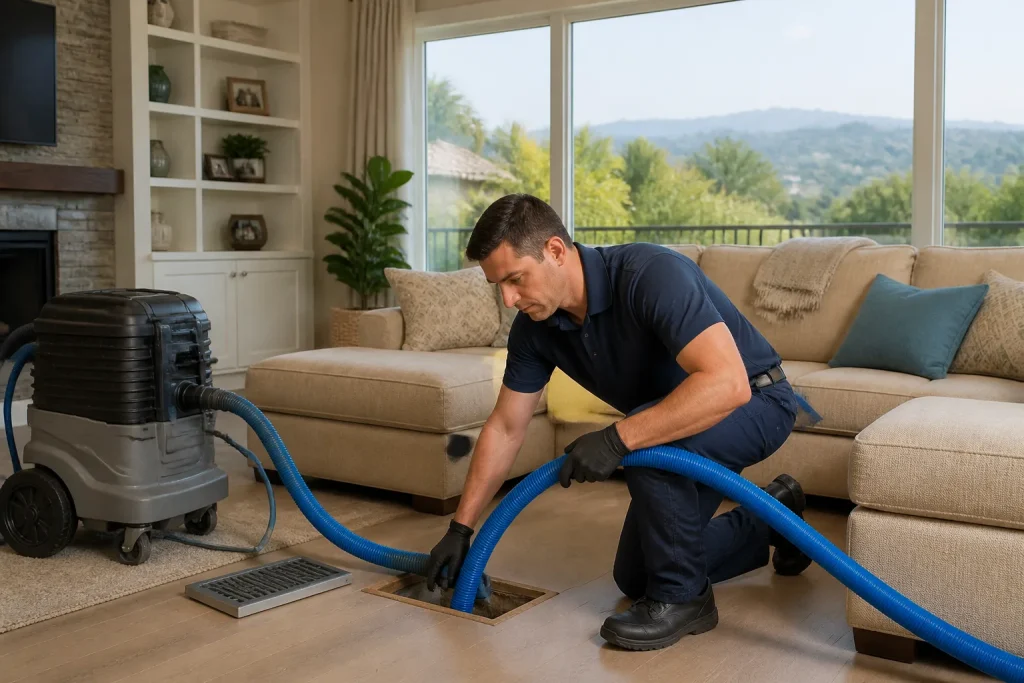
- Set up negative pressure and clean the duct runs with rotary brush and HEPA equipment.
- Clean the cabinet interior and the return plenum.
- Reinstall the dry cells and new media.
That sequence is what makes the difference between a duct cleaning and a real indoor air quality service. We run Rotobrush and Nikro equipment together for exactly this reason: dislodging and capture in the same pass, after the components are out of the way.
The Bypass Humidifier Problem Nobody Talks About
A bypass humidifier is one of the most overlooked contamination sources in an Encino home with a Honeywell system, and it sits closer to your supply air than almost anything else in the house.
The HM750A works by running water over a distribution tray and evaporative pad, with air bypassing through the pad and back into the supply. The drain pan underneath catches what doesn’t evaporate. That pan and tray stay damp for long stretches, and damp surfaces grow things. If a duct cleaning happens without addressing the humidifier pan, tray, and pad in the same visit, you’ve cleaned the ducts and left a biological growth source connected to them by a short piece of bypass duct.
Winters in Encino are mild, so homeowners often figure the humidifier doesn’t matter much. But the unit doesn’t disappear when you stop running it. It sits there, connected to the system, holding moisture and debris. Servicing it means:
- Pulling the water panel and inspecting the tray and pan for growth.
- Cleaning and sanitizing those surfaces.
- Checking the drain line for clogs and the water supply for scale.
- Replacing the pad so you’re not reintroducing what you just removed.
If you’re dealing with contamination concerns beyond ordinary dust, this is where remediation-grade equipment earns its keep. Our Abatement Technologies systems are built for environments where air quality intervention needs to be documented, not just claimed.
Filter Timing: Don’t Reinstall a Loaded Media Filter
Cleaning the ducts and then sliding the old Honeywell F100 media filter back into the cabinet defeats a good chunk of the work. The filter is the last line of defense before your blower, and if it’s loaded, it’s already saturated with the particulate you just paid to remove.
The timing is simple once you think about it: replace the media filter as part of the same service visit, after the ducts are clean. A fresh filter on a clean system starts its service life with a clean slate. Reusing a loaded one means the blower pulls harder against a clogged filter, airflow drops, and the system runs less efficiently from day one.
Here’s the honest part that most companies won’t tell you: we find it helpful to check the filter cabinet itself, not just the filter. A cabinet with gaps or a poor seal lets air bypass the media entirely, so dust that should be trapped ends up in your ducts. In our experience, a sealing detail you catch during cleaning saves a callback later. That’s why we offer duct repair and sealing in-house. We find the problem, then fix it before we leave.
What to Ask Before You Let Anyone Near Your Honeywell System
Not every duct cleaner is set up for Honeywell integration, and asking a few direct questions before the work starts will tell you quickly whether you’re dealing with someone who knows these systems or someone who doesn’t.
Ask these questions, and listen for specific answers:
- “Will you remove and wash the electronic cells before you start cleaning?” If the answer is vague or they plan to clean around the unit, that’s your signal.
- “How will you handle the bypass humidifier pan and tray?” A cleaner who doesn’t inspect those surfaces isn’t doing whole-system work.
- “What equipment are you running?” Professional-grade names should come up. “Shop vac” is not an air quality service.
- “Who replaces the media filter, and when?” The answer should land inside the same visit.
- “Can you repair duct leaks you find?” A full-system approach fixes what it finds instead of handing you a referral.
Someone who works with Honeywell systems regularly will answer these without hesitation. That familiarity is what separates a real service from a coupon-driven one.
When to Call a Pro
If you’re not comfortable pulling the collector cells on an electronic air cleaner or you’re not sure whether your humidifier has been serviced, leave it to a trained technician. A bypass humidifier connected to a system with growth concerns, or an electronic air cleaner with failing electrical components, is not a DIY project. The system is wired into your HVAC, and the contamination concerns go beyond what a homeowner can inspect by eye.
Related services in Encino: if you’re already having us out, it’s worth asking about dryer vent cleaning in the same visit, since lint buildup is its own fire hazard. And for a deeper look at the whole forced-air system, our air duct cleaning page covers the basics, while HVAC cleaning addresses the unit itself. If you’re thinking about upgrading after cleaning, Honeywell and Aprilaire product lines give you whole-home filtration and humidity control as a natural next step. Cleaner air starts at the source, and that source is a clean, sealed, well-filtered system.
The Bottom Line
Honeywell whole-home air systems are common in Encino homes, and they change how a duct cleaning should be done. The electronic cells, bypass humidifier pan, and media filter all sit in the air path, and servicing them first is what makes the rest of the work count. Cleaning around Honeywell components instead of through them leaves contamination where it was.
The takeaways worth keeping:
- Pull and wash electronic cells before negative-pressure cleaning.
- Service the bypass humidifier pan, tray, and pad in the same visit.
- Replace media filter after cleaning, not before.
- Ask direct questions about equipment and Honeywell familiarity before booking.
- Fix duct leaks and gaps during the job, not after a callback.
Our technicians have up to 13 years of experience, and our work runs on Rotobrush and Nikro equipment with Abatement Technologies systems for jobs that need remediation-level care. If you’re in Encino and need help, Air Duct Cleaning Encino offers free estimates. Call (877) 492-1986. We answer 24/7, with fast dispatch from 7am to 7pm, Sunday through Friday. One flat price per system, agreed before work starts, and before-and-after photos so you can see what changed.
Frequently Asked Questions
Yes, and the cells get removed and washed before cleaning starts, not after. That order keeps contaminated media from being redistributed through the system you’re paying to clean. If a technician wants to clean around the air cleaner, ask why.
Most homes do fine with a cleaning every few years, but Honeywell systems with electronic air cleaners, humidifiers, and ventilation units have components that need attention more often than the ducts themselves. Check those parts yearly and schedule duct cleaning when you notice visible buildup or a change in airflow. Call (877) 492-1986 for an exact quote; estimates are free.
Cheap quotes usually skip the components. If a price doesn’t include pulling and washing the electronic cells, servicing the humidifier pan and tray, and replacing media, you’re paying for a partial job. The cleaning looks done, but the source of contamination stays in the air path. A written estimate that lists each component is worth more than a low number with gaps. Call (877) 492-1986 and ask what’s included.
Ask for before-and-after photos of your own ducts and components, not stock images. With Honeywell systems, you should also get confirmation that the electronic cells were washed and reinstalled and that the humidifier pan was serviced. If it’s not documented, ask. Call (877) 492-1986 for an estimate that spells out the scope.
Written by the team at Air Duct Cleaning Encino.
Need Air Duct Cleaning Help?
Call Air Duct Cleaning Encino - the local pro we connect you with is licensed and insured, with free written estimates in Encino.
(877) 492-1986