
Last updated November 22, 2026
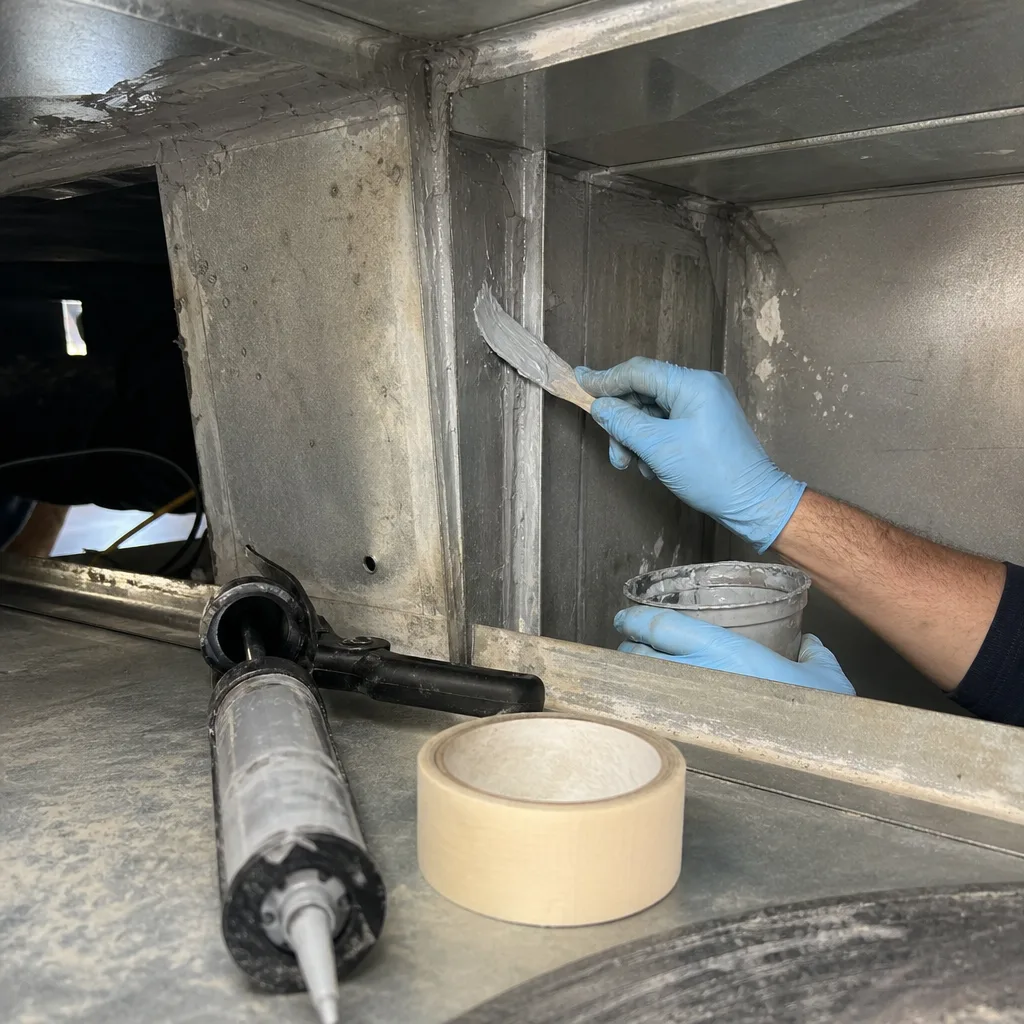
 Whole-home duct cleaning
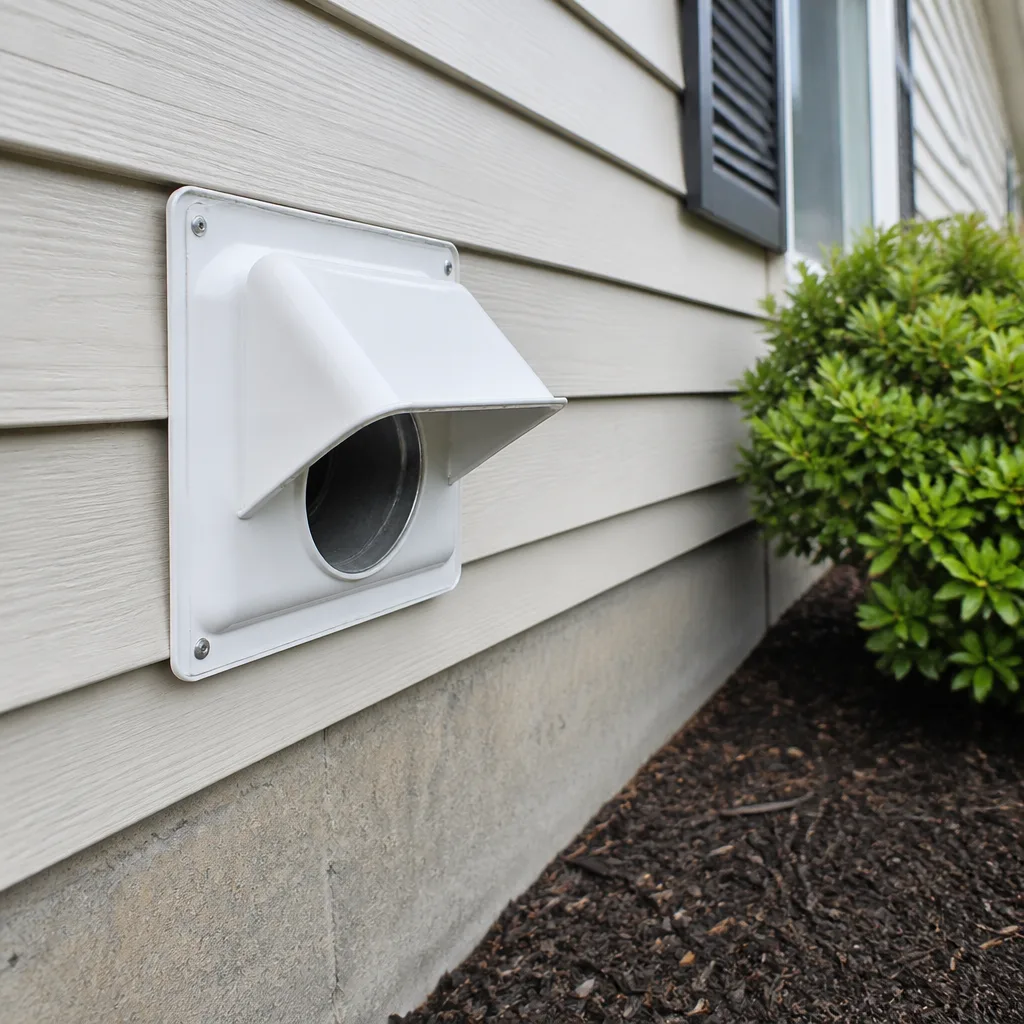 Dryer vent cleaning
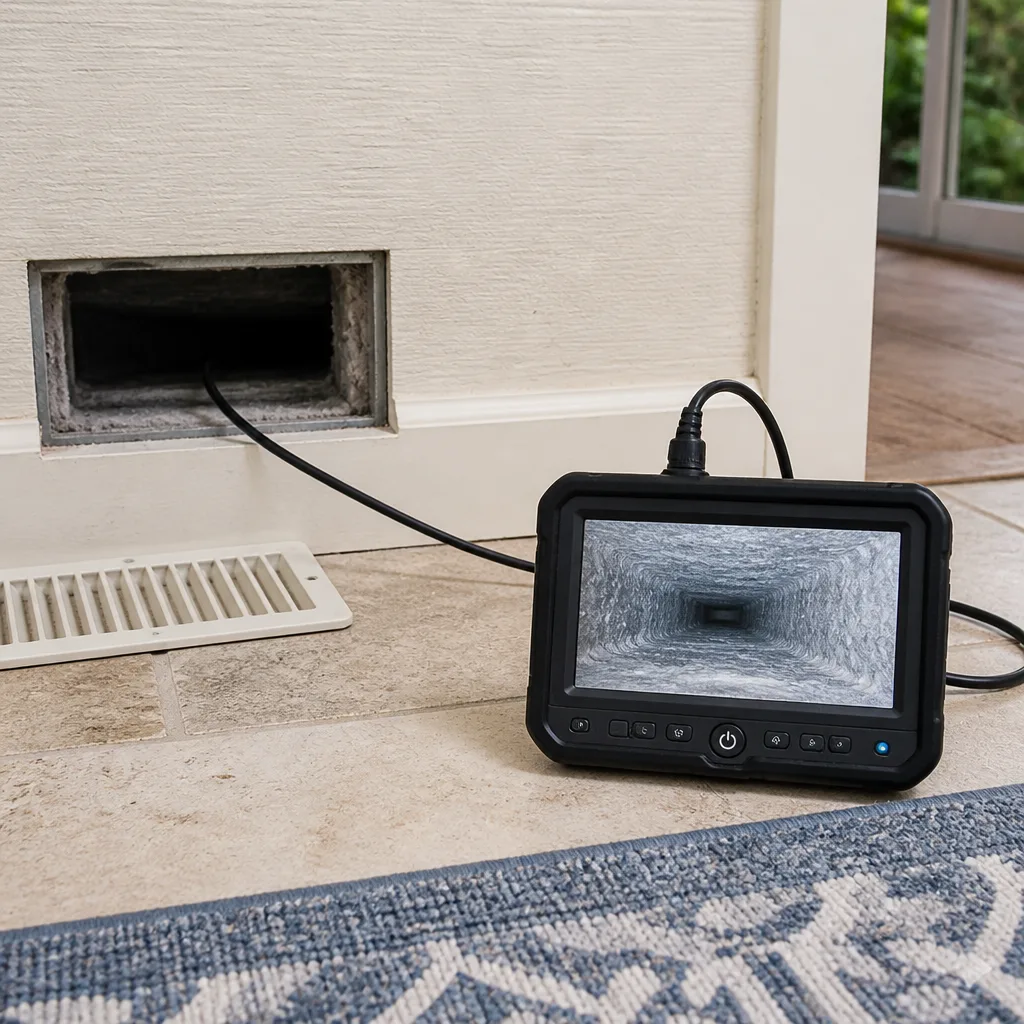 Camera inspection
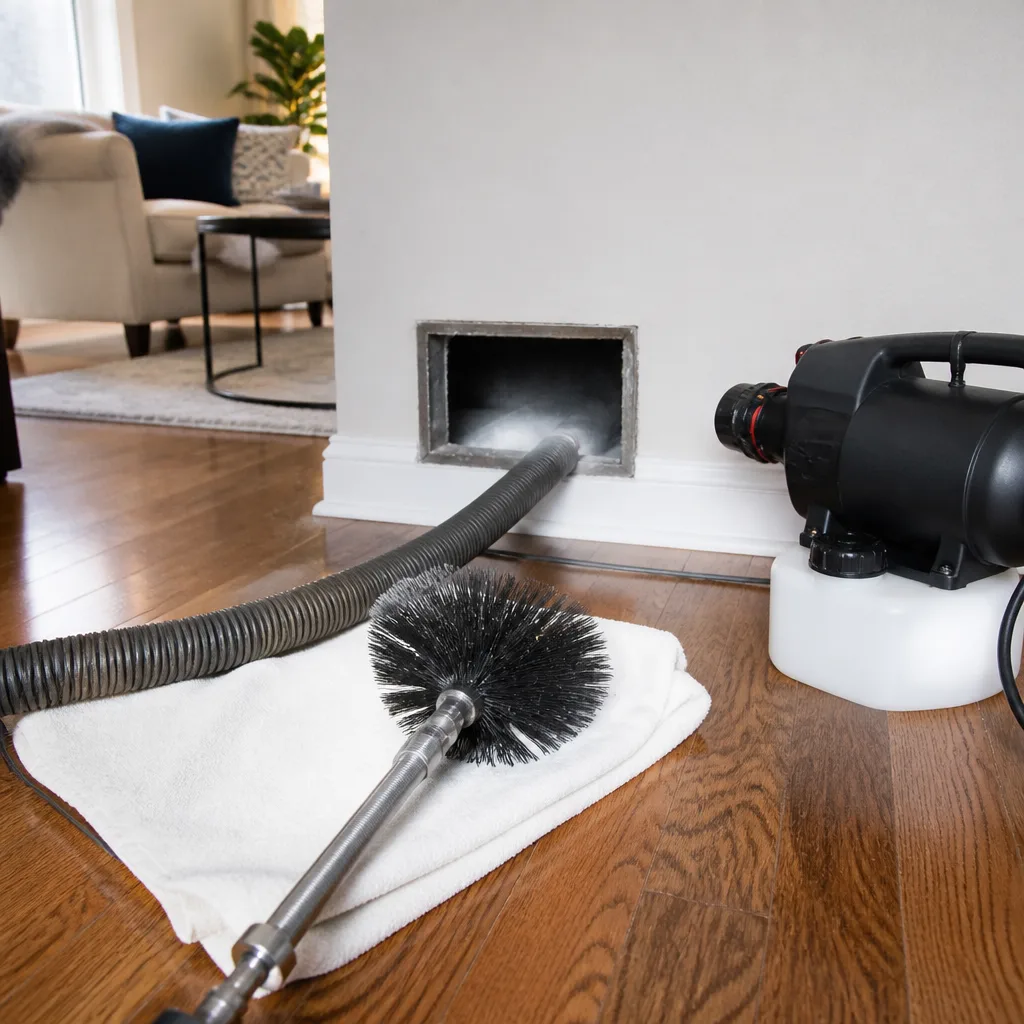 Sanitizing & deodorizing
Whole-system duct and dryer vent check with before-and-after photos - you see exactly what came out of your vents
That "$99 whole-house special" is a bait ad - the real number appears once they are in your hallway, or the "clean" is a shop-vac at the register. We photograph the inside of your ducts before and after instead.
DIY vs Professional Air Duct Cleaning: The Encino Homeowner’s Decision Guide
Attaching a brush to a shop-vac and running it down a floor register feels like it should work. You see dust come out, the register face looks cleaner, and the whole job costs nothing but an afternoon. Here’s the problem: what you just cleaned is the last six inches of a duct system that runs thirty, forty, sometimes sixty feet through walls, ceilings, and the attic. The contamination that actually matters is coating the inside of the trunk line ten or fifteen feet from the air handler, and a shop-vac has no realistic effect on it. This guide explains why, in physical terms rather than sales terms, and then draws a clear line between the duct maintenance you can do yourself and the work that requires equipment built for the job. We’ll cover what DIY genuinely accomplishes in an Encino home, where it can cause damage, and how to decide which category your situation falls into.
Quick Answer
DIY air duct maintenance is legitimately useful for three things: keeping register grilles clean, changing filters on schedule, and visually inspecting accessible flex duct for obvious damage. It cannot clean the interior of your duct system, because consumer vacuums can’t generate the negative pressure required to dislodge embedded contamination and hold it in suspension. Professional cleaning works on a different physical principle: sealed negative pressure at 10 to 20 times the level a shop-vac produces, combined with mechanical agitation from a rotary brush, is what actually pulls settled debris off duct walls and captures it before it re-enters your living space.
Styles & brands we work with
- Whole-home duct cleaning
- Dryer vent cleaning
- Camera inspection
- Sanitizing & deodorizing
Table of Contents
- Why Negative Pressure, Not Brushing, Is the Whole Mechanism
- What DIY Duct Maintenance Actually Accomplishes
- How DIY Attempts Cause Real Damage
- Encino Conditions Where DIY Is the Wrong Call
- Cost-Benefit: Annual DIY vs Deferred Professional Cleaning
- What Professional Equipment Actually Does Differently
- How to Decide: A Step-by-Step Assessment
- Frequently Asked Questions
Why Negative Pressure, Not Brushing, Is the Whole Mechanism
Most homeowners assume duct cleaning is about scrubbing. It isn’t. Scrubbing is the second half of the process; the first half, and the one that determines whether the job works at all, is creating a pressure differential across the entire duct system and holding it while the walls are agitated.
Here’s what that means in practical terms. A shop-vac generates suction in the range of a few inches of water column at the hose opening, and that number collapses the moment you add thirty feet of hose and a brush head. By the time the airflow reaches the far end of a trunk line, there’s barely enough lift to move loose surface dust, let alone contamination that’s bonded to the duct wall through years of condensation cycles and temperature swings.
Professional equipment works the other way around. A truck-mounted or high-capacity HEPA unit connects to the system at a single point, typically the main trunk or the air handler plenum, and pulls the entire duct network into negative pressure. Every register and return in the house is then drawing air inward. When a rotary brush is fed through each run, the debris it loosens has nowhere to go but into the collection unit, because the whole system is pulling that direction.
Three things have to be true at once for this to work:
- One sealed connection point. The vacuum ties into the system and every other opening is either being worked or temporarily covered, so pressure doesn’t leak out through open registers.
- Enough static pressure to move bonded debris. This is the 10 to 20x difference. Consumer equipment can’t reach it; remediation-grade HEPA units can.
- Mechanical agitation during the pull. A rotary brush, not a blast of air, contacts the duct wall and lifts contamination into the airstream being pulled toward the collection unit.
That combination is why professional duct cleaning is a pressure problem more than a scrubbing problem, and it’s the reason a shop-vac setup can’t be scaled up into the same job with more effort. The physics doesn’t cooperate. When we run air duct cleaning in an Encino home, the rotary brush and the HEPA vacuum work together in one pass rather than as separate steps, which is what lets the debris leave the system instead of settling back onto the walls a few minutes later.
What DIY Duct Maintenance Actually Accomplishes
There’s a real role for homeowner maintenance. It just isn’t duct cleaning. Here’s what you can legitimately do yourself, and how to do each one without causing problems.
1. Register and grille cleaning
The register face and the visible collar behind it collect a surprising amount of dust because they sit at the boundary between the duct and the room. Remove the grille (most are held by two screws), wash it in warm soapy water, dry it fully, and wipe the visible collar with a damp cloth. Don’t spray cleaner into the duct opening; you want to remove what’s accessible, not push moisture or chemical residue into the run.
2. Filter replacement on schedule
This is the highest-return maintenance item in the entire system and the one most homeowners get wrong. Check the filter monthly during heavy cooling season, replace or clean it per the manufacturer’s interval, and match the MERV rating to what your air handler is rated for. A filter that’s too restrictive for the blower can reduce airflow and strain the system. If you’re unsure what your unit calls for, the spec plate inside the air handler access panel states it.
3. Visual inspection of accessible flex duct
Where flex duct is visible in an attic, garage, or crawlspace, you can look for kinks, crushed sections, disconnected collars, or obvious tears in the outer jacket. Photograph anything that looks wrong and address it with a technician. Visual inspection is safe. Physical probing with a tool is not, and we’ll cover why next.
4. Keeping returns clear
Return air has to have a path. Furniture pushed against a return grille, curtains draped over it, or a rug covering a floor return all starve the system and increase the velocity at the remaining returns, which pulls more dust into the ductwork. A two-minute furniture check a couple of times a year is genuinely useful maintenance.
That’s the honest scope of DIY. Everything past this point either requires equipment you don’t have or risks damage you don’t want. Our technicians have up to 13 years of experience, and the calls we get after a DIY attempt usually center on one of the four failure modes below.
How DIY Attempts Cause Real Damage
Duct systems are more fragile than they look, particularly the flex duct that makes up most of the runs in Southern California homes built or retrofitted in the last thirty years. Here’s where DIY goes wrong.
Flex duct puncture from stiff brushes
The interior liner of flex duct is a thin plastic membrane, often only a few mils thick, stretched over a wire helix. A stiff bristle brush fed by hand catches on the helix, twists, and tears through the liner. Once the inner liner is breached, the insulation between the liner and the outer jacket becomes a dust trap and, in a humid season, a condensation point. You’ve traded a dirty duct for a damaged one.
Dislodging debris without capture containment
This is the most common DIY outcome. A homeowner runs a brush or a blower through a run without the system under negative pressure. The debris comes loose, gets pushed toward the nearest register or the air handler, and either blows into the room or settles in a new location. Some of it lands in the blower compartment. Some of it coats the evaporator coil. The duct may look cleaner at the register, but the contamination has just been redistributed into places that are harder and more expensive to clean.
Disturbing older insulated duct liners
Internal duct insulation, common in older homes in Encino and the surrounding Valley neighborhoods, degrades over time. The facing can be brittle and partially detached. Mechanical agitation from a hand-fed brush can tear it loose, and the resulting fiberglass particles then travel through the supply system into the living space. Professional cleaning accounts for this: technicians assess liner condition before agitating and use lower-pressure methods or targeted repair when the liner is compromised.
Damaging the air handler while “cleaning” the plenum
The plenum and the blower compartment are not places to experiment. Reaching into the blower housing with a vacuum nozzle can bend the blower wheel fins, which throws the wheel out of balance and creates noise and vibration that persists long after the cleaning. The evaporator coil fins are also easily bent, and bent fins reduce heat transfer efficiency. These are the components that a proper HVAC cleaning service addresses with the right tools and the right sequence.
Encino Conditions Where DIY Is the Wrong Call
Encino sits in the San Fernando Valley, and that geography produces specific conditions that put a home’s duct system in a different category than ordinary dust accumulation. Three scenarios come up regularly, and in all three, DIY is not just ineffective, it’s the wrong tool for a health-related problem.
Post-fire smoke residue
Smoke residue from a regional fire event doesn’t behave like dust. It’s a mix of fine particulates and volatile organic compounds that deposit on duct surfaces, and it keeps off-gassing long after the fire is out. A shop-vac cannot remove it because the particles are smaller than typical vacuum filtration can capture, and agitation without HEPA-level containment can actually increase the amount of residue circulating in the home. Remediation-grade HEPA equipment and antimicrobial treatment are the appropriate response, and this is where Abatement Technologies equipment in the hands of trained technicians makes a real difference.
Suspected mold growth
Mold in a duct system is a moisture problem first and a cleaning problem second. If you see visible growth at a register or smell the musty signature of mold when the system runs, the issue has usually developed where condensation collects: on the evaporator coil, in the drain pan, or in a section of duct with compromised insulation. Vacuuming the visible growth without addressing the moisture source just moves spores. Professional remediation combines containment, HEPA extraction, and surface treatment, and it includes identifying and correcting the moisture problem so the growth doesn’t return.
Renovation debris
Drywall dust, sawdust, and construction particulate behave differently from household dust. They’re finer, they travel further, and they settle into the duct system in volumes that a shop-vac can’t handle without repeatedly clogging. Post-renovation duct cleaning in an Encino home also typically requires checking that return grilles weren’t temporarily sealed and forgotten, and that no construction debris was dropped into open registers during the work. This is a job for a full-system approach, not a room-by-room effort.
In all three of these situations, the reason to call a professional isn’t that the work is hard. It’s that the contamination is in a category where improper handling makes things worse. That’s the point at which the honest answer is: this needs equipment and process you can’t replicate at home.
Cost-Benefit: Annual DIY vs Deferred Professional Cleaning
Here’s where a fair comparison gets made. DIY maintenance saves real money on the things it can do. What it doesn’t do is prevent the slow accumulation that eventually reaches the components where cleaning gets expensive. The table below lays out the trade honestly.
| Item | DIY Approach | Professional Approach |
|---|---|---|
| Filter replacement | Cost of filters, done on schedule | Same; we recommend you keep doing this |
| Register cleaning | Free, effective | Included in service |
| Duct interior cleaning | Not achievable | Full-system extraction with rotary agitation |
| Coil and drain pan cleaning | Not appropriate for DIY | Included in HVAC cleaning service |
| Duct repair and sealing | Not achievable | Done in-house during the same visit |
| Post-fire or mold remediation | Not safe or effective | Remediation-grade HEPA and antimicrobial treatment |
| Typical cost | Low per year, but limited in scope | Priced per job by written estimate |
The honest arithmetic: DIY maintenance is worth doing, and you should keep doing it. The cost of skipping professional cleaning isn’t a single big bill; it’s the compounding effect of contamination that reaches the evaporator coil and drain pan. A coil that’s coated with dust loses heat transfer efficiency, which means the system runs longer to reach the same temperature. A drain pan that’s accumulating debris becomes a moisture trap, and that’s where the conditions for mold growth begin. By the time the symptoms are obvious (higher utility bills, musty smell, reduced airflow at distant registers), the cleaning job has grown to include components that weren’t part of the original picture.
The other cost of deferral is the one most homeowners don’t think about: the contamination gets harder to remove the longer it’s bonded to the duct wall. Cleaning a system that’s been maintained is a different job than restoring one that hasn’t. If you want to know what a specific job in your home looks like, our estimates are free.
What Professional Equipment Actually Does Differently
Most residential duct cleaners run one method. We run two together, because the two methods address different halves of the same problem.
Rotary brush agitation
A flexible rotary brush is fed through each duct run from the register end, rotating against the duct wall as it advances. The brush contacts and lifts contamination that’s bonded to the surface. On its own, a rotary brush loosens debris without capturing it. That’s why it’s paired with the second system.
HEPA negative-pressure extraction
A high-capacity Nikro HEPA vacuum is connected to the system and pulls the entire duct network into negative pressure. Everything the rotary brush dislodges has one path: into the HEPA collection unit. Because the filter media captures particles at the sub-micron level, the exhaust from the unit is cleaner than the air in the room. This is the same principle specified in NADCA-standard commercial cleanings, and it’s the reason professional cleaning doesn’t just redistribute contamination.
Remediation-grade capability
Abatement Technologies equipment is what separates a standard residential cleaning from a remediation-level job. It’s the equipment used when contamination exceeds ordinary dust and requires containment, higher filtration, and documented process. Not every home needs it, but a home that’s had a fire, a mold event, or a major renovation does, and standard residential equipment doesn’t get you there.
Repair, sealing, and air quality upgrades
Cleaning is often the start of the work, not the end. If the assessment turns up leaks, disconnected collars, or damaged sections, our team seals and repairs them during the same visit rather than referring the work out. And when the ducts are clean and sealed, that’s the point at which whole-home filtration or humidity control makes sense. We work with Honeywell and Aprilaire systems, so an air quality upgrade can follow the cleaning in a way that starts from a clean, sealed system instead of covering over a dirty one.
How to Decide: A Step-by-Step Assessment
Work through this sequence honestly. Most homeowners land on a clear answer by the end of it.
- Check your filter and register condition first. If the filter is loaded and the registers are visibly dusty, start with filter replacement and register cleaning. Live with it for two weeks and note whether visible dust settles on surfaces again quickly. If it does, the source is likely deeper than the registers.
- Note any smell when the system starts. A musty or smoky smell in the first thirty seconds of a cooling cycle is the system telling you something is in the ducts or on the coil. This moves you into the professional category immediately.
- Look for visible dust trails at supply registers. Streaks of dust radiating from register louvers usually mean the supply run is releasing debris, which points to duct interior contamination rather than room dust.
- Consider recent events. Fire in the region, a renovation in the home, a water intrusion anywhere in the system, or visible growth at any register all push the decision toward professional service.
- Assess the age of the home’s duct work. In an older Encino home with original flex duct, the liner condition matters as much as the cleaning. A proper assessment includes checking whether the duct can tolerate cleaning without damage.
- Check your dryer vent separately. This is a fire-safety issue and it’s independent of duct cleaning. If the dryer takes longer than it used to, the vent is restricted. Our dryer vent cleaning addresses the entire vent run, not just the visible section.
- Decide what you’re actually solving. If it’s routine dust and you’re staying on top of filters and registers, DIY is a reasonable answer. If it’s air quality, system efficiency, or post-event remediation, the decision has made itself.
Common Mistakes to Avoid
- Assuming visible register dust means you know the condition of the ducts. The register face is the least representative part of the system. The condition of the trunk line and the coil is what matters, and neither is visible without inspection.
- Running a brush without negative pressure. This is the single most damaging common mistake. Agitating a duct without capture containment redistributes contamination into the air handler and the living space.
- Using a shop-vac as if it were a duct cleaning system. A shop-vac attached to a brush can reach the first few feet of a run at very low suction. It has no effect on the interior of the trunk line, which is where most contamination lives.
- Choosing a quote based on price alone without asking what equipment is used. Duct cleaning without HEPA extraction and rotary agitation isn’t really cleaning. It’s stirring. Ask what systems the company uses before you compare prices.
- Ignoring a musty smell and hoping it’s temporary. In Encino’s dry climate, a musty smell in the ducts almost always points to a moisture source that needs to be found. Covering it with air fresheners makes it invisible without solving it.
- Forgetting the dryer vent. The dryer vent is the highest fire-risk component of the forced-air system, and it’s completely separate from the supply and return ducts. It needs its own cleaning on its own schedule.
- Skipping the post-renovation cleaning. Construction debris in the ducts can travel to the blower and coil and stay there. A renovation is the one time a “we’ll get to it later” approach predictably turns into a larger job.
See the difference
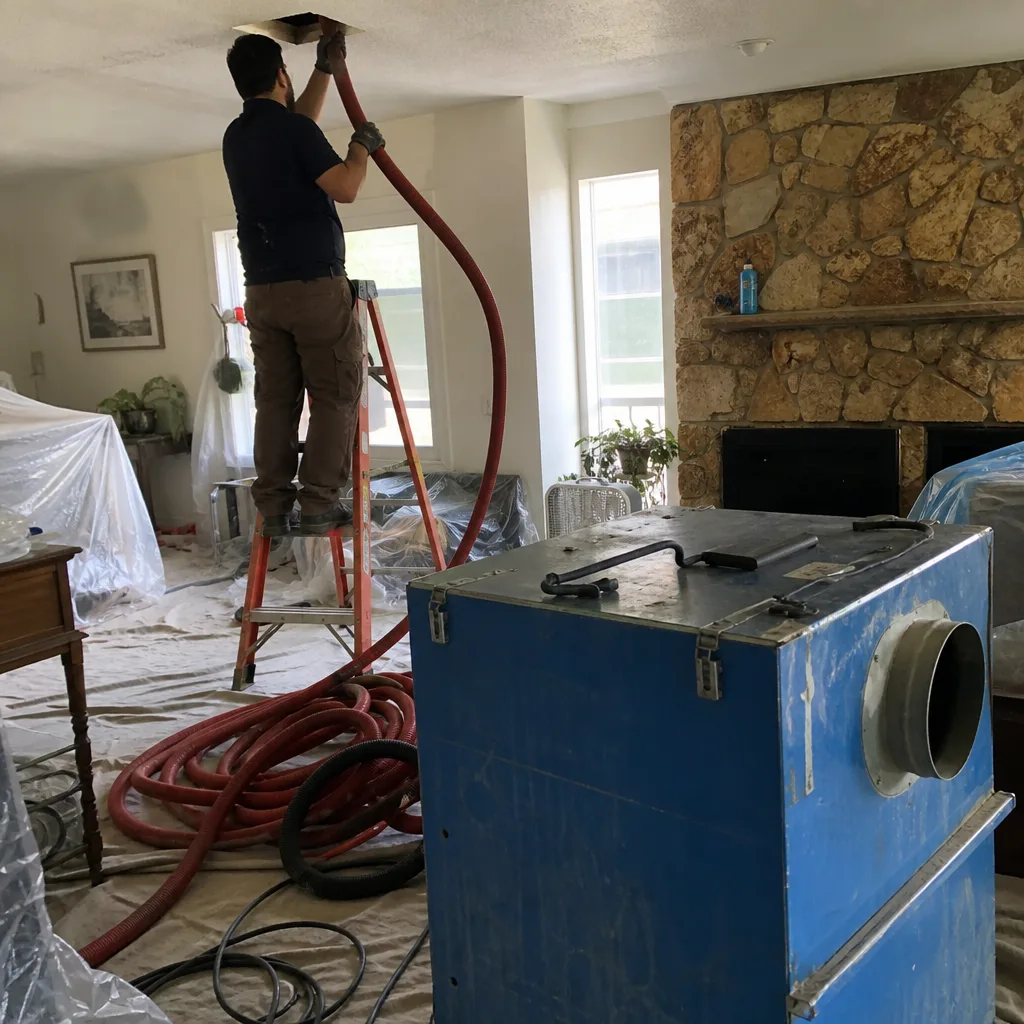 Before
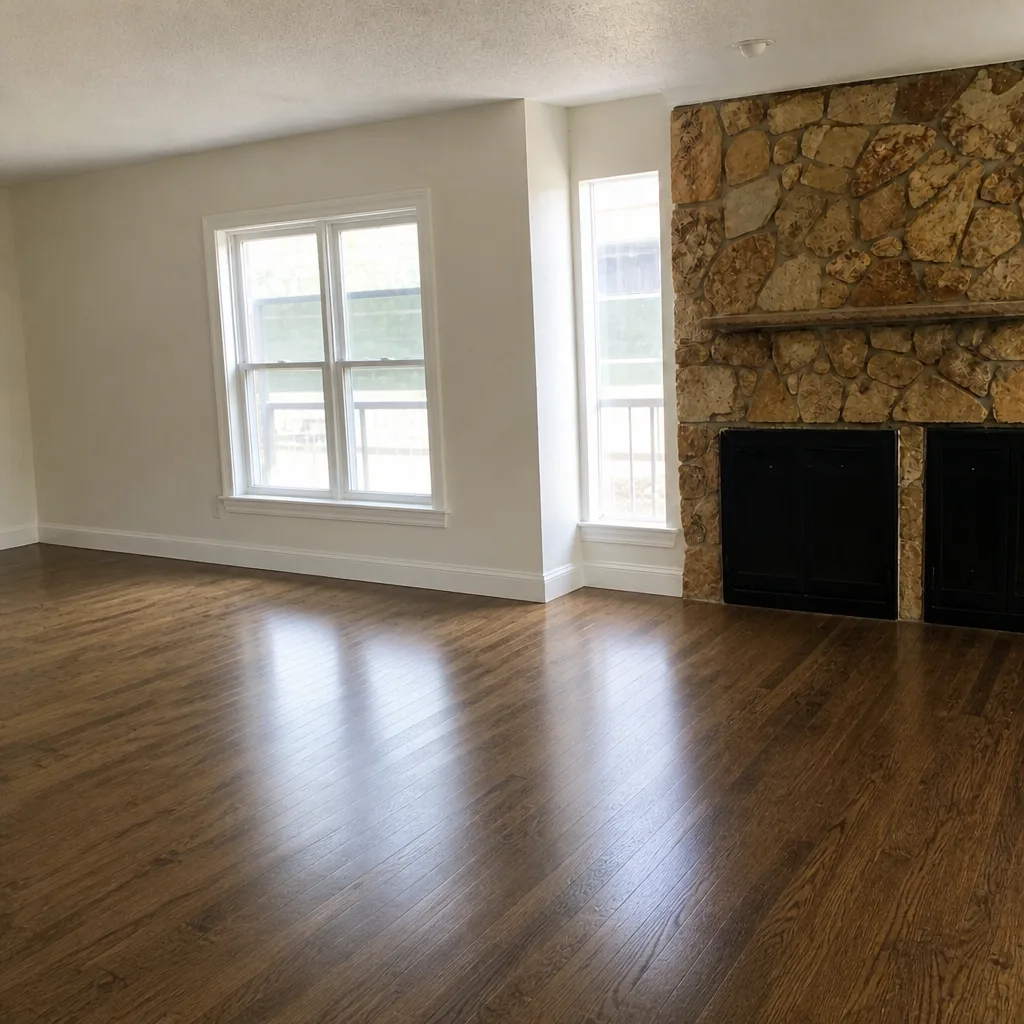 After
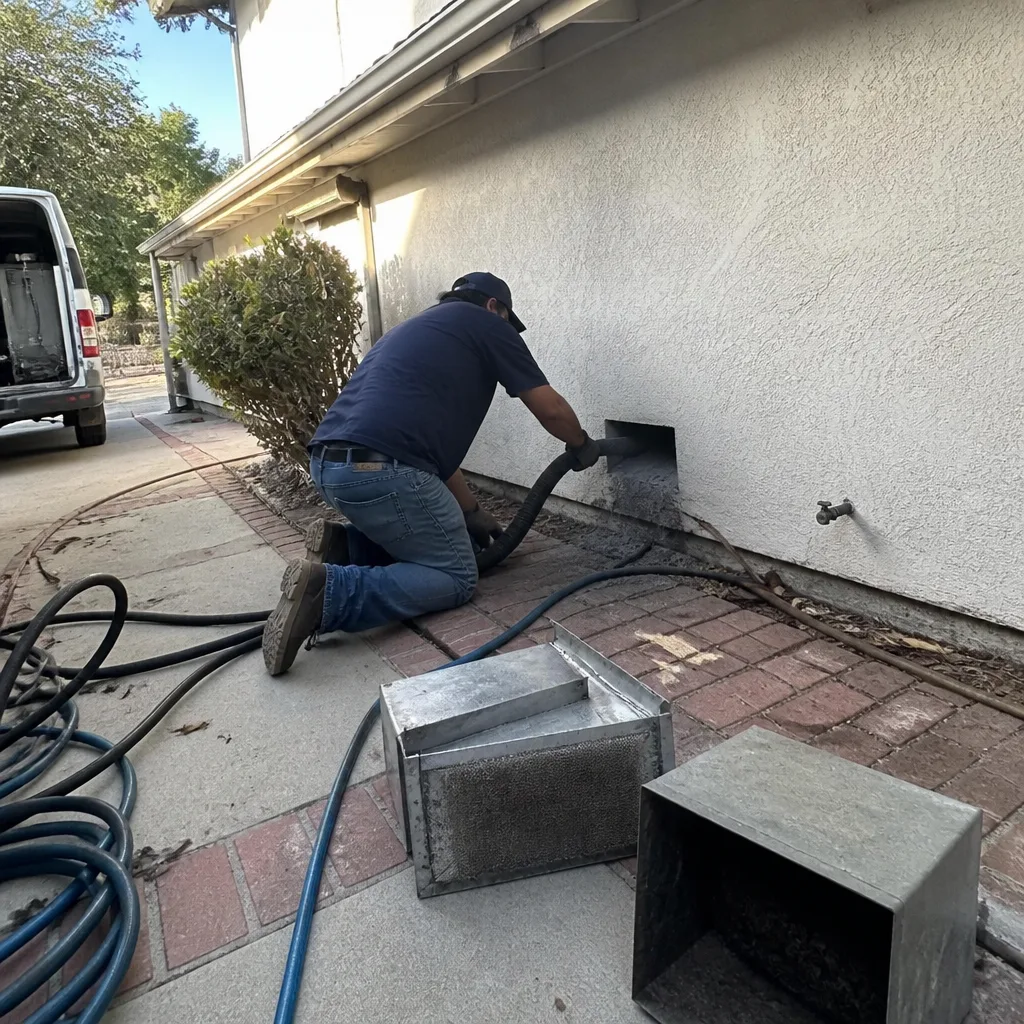 Before
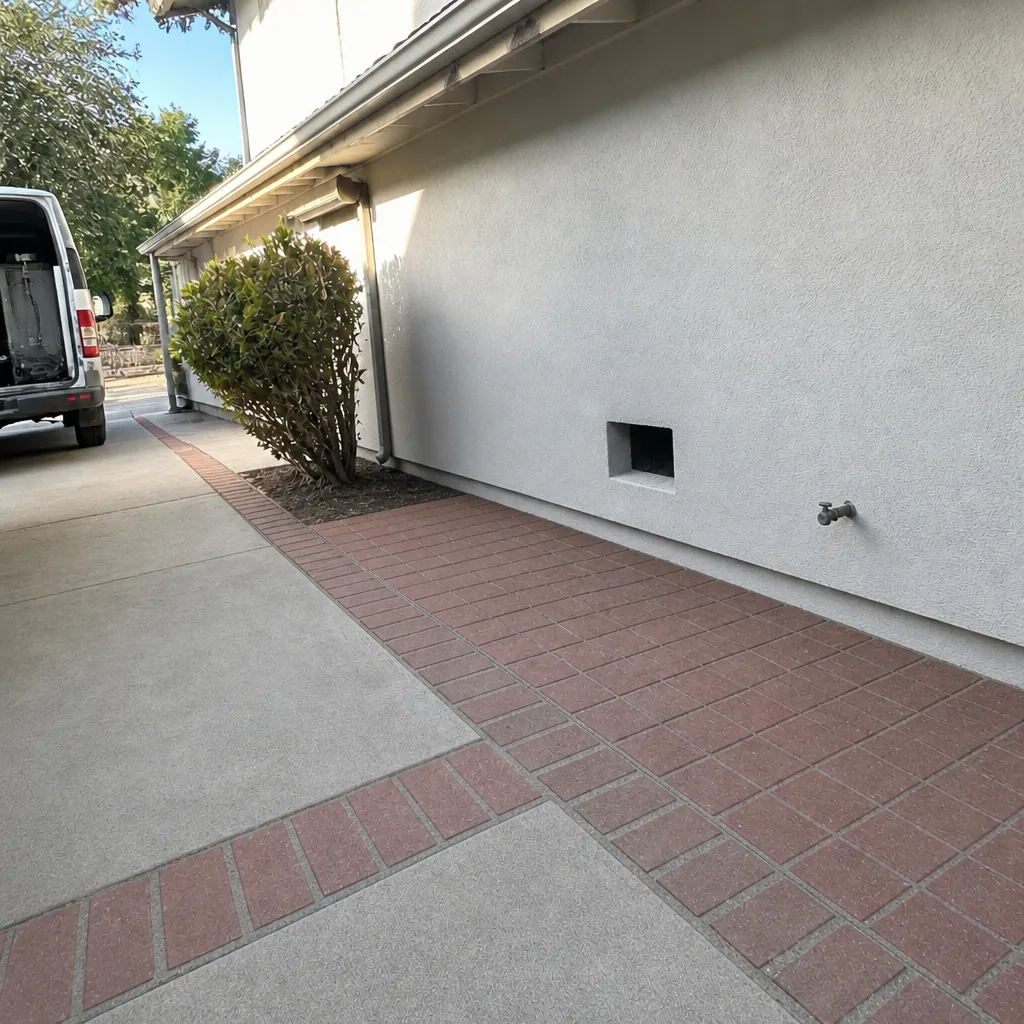 After
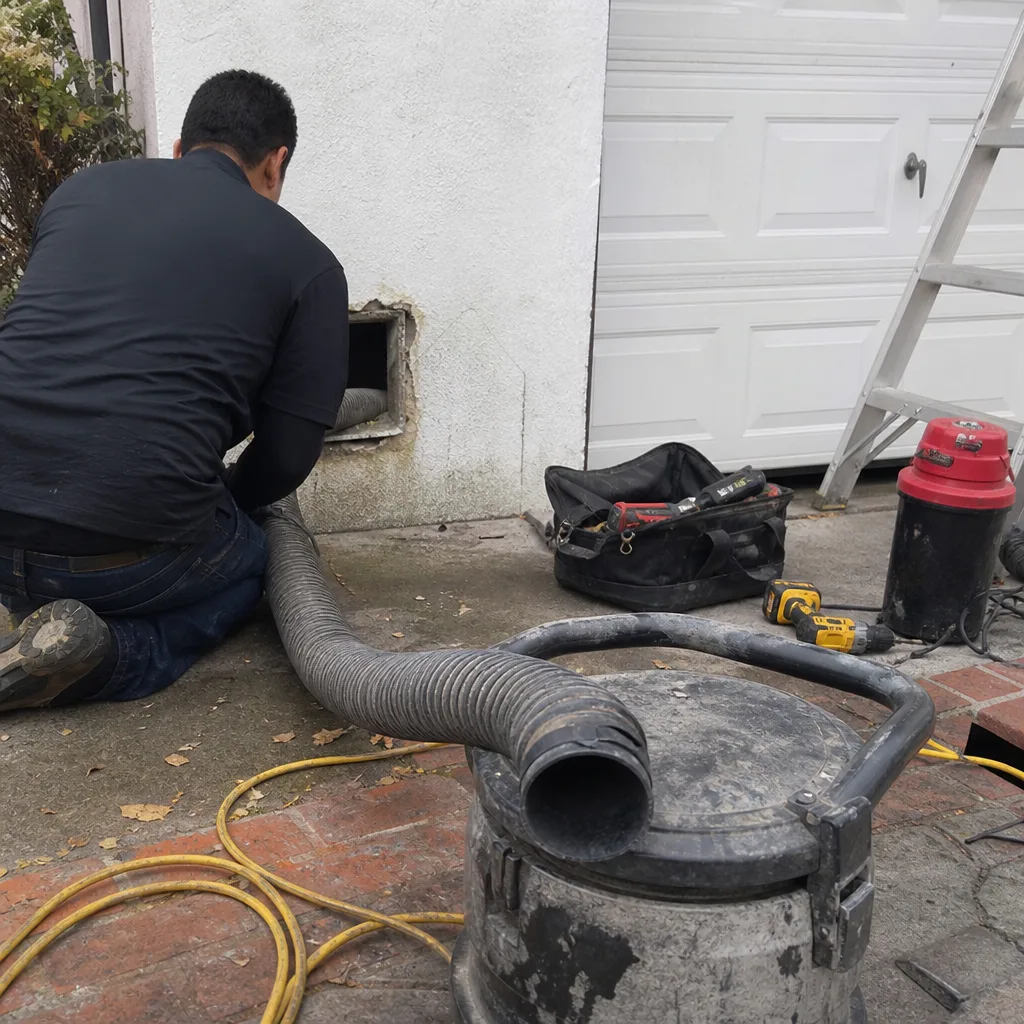 Before
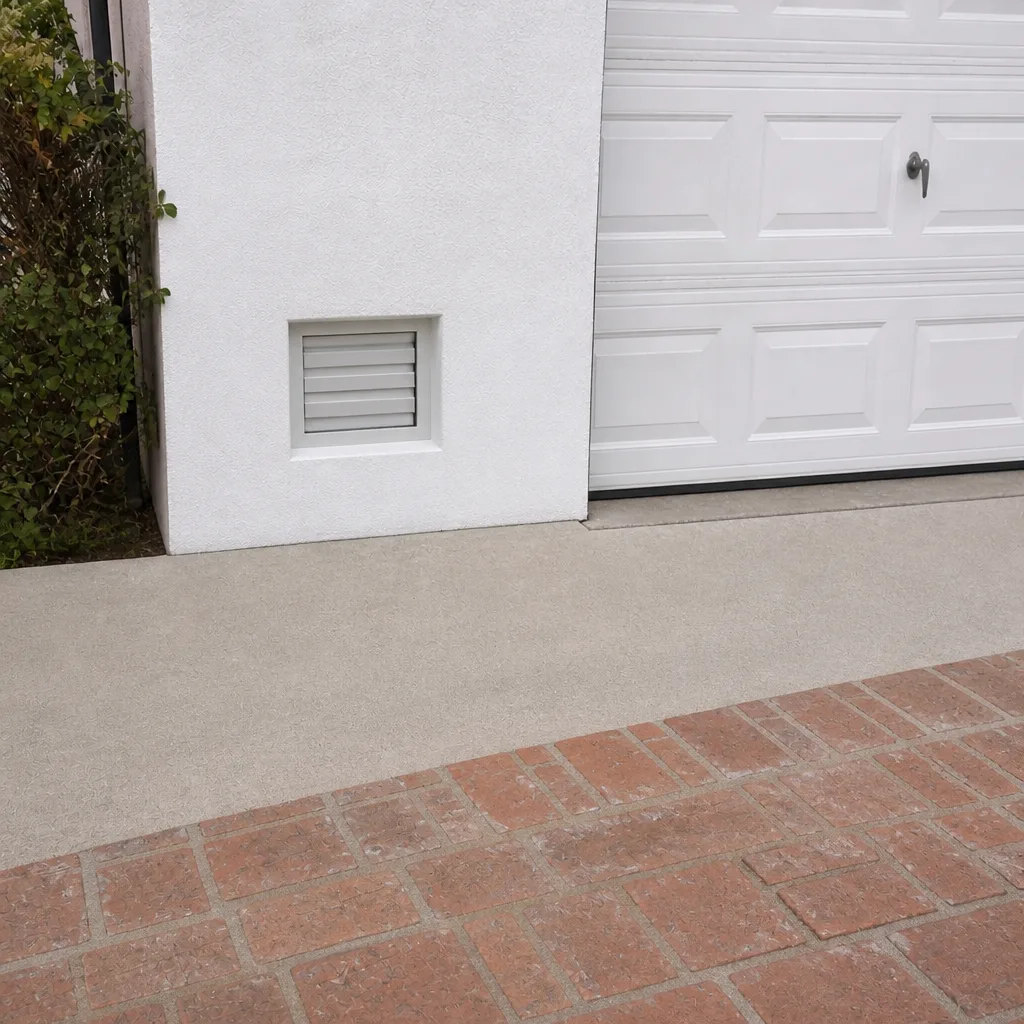 After
When to Call a Professional
Call a professional when any of the following is true: the system has been exposed to smoke from a regional fire event; there’s a musty smell on startup or visible growth at any register; there’s been a renovation in the home; the duct work shows visible damage, disconnection, or crushed sections; the system hasn’t been cleaned in many years and you’re not sure of its history; or you’ve tried the DIY maintenance steps and the dust returns within days. In each of these cases, the limitation isn’t effort. It’s that the physics of the job requires sealed negative pressure, HEPA extraction, and mechanical agitation at a level consumer equipment can’t produce. The right call is to get an assessment from someone running equipment built for the work.
Air Duct Cleaning Encino offers free estimates in Encino. Call (877) 492-1986. We answer 24/7. Fast dispatch from 7am to 7pm, Sunday through Friday. Every job is priced per system by written estimate before work starts, so you know the scope and the cost up front.
Frequently Asked Questions
No, not in any meaningful sense. A shop-vac can clean the visible register face and the first few inches of a duct run, but it can’t generate enough negative pressure to dislodge contamination bonded to the interior of your trunk line or reach the components where buildup actually matters. If your goal is cleaner air and better system performance, the shop-vac approach won’t get you there. Call (877) 492-1986 for a free estimate on what a full-system cleaning involves in your home.
The price depends on the size of the system, the number of runs, the condition of the ducts, and whether the work extends to HVAC cleaning or repair. We price per system by written estimate, not per vent, so you know the full number before any work starts. Sketchy quotes that look too cheap are usually cheap for a reason: no HEPA extraction, no rotary agitation, and a price that grows once the technician is on site. Call (877) 492-1986 and we’ll give you an honest estimate for your specific home.
Because they’re quoting a different service. A low quote usually means a shop-vac-style approach without proper HEPA extraction, without rotary brush agitation, and often without any real inspection of the coil or the duct condition. That’s not a bargain for the homeowner; it’s a job that leaves the contamination in place or redistributes it. We run Rotobrush rotary agitation and Nikro HEPA extraction together, and the estimate reflects a job that actually removes what’s in the ducts. Call (877) 492-1986 to compare on capability rather than price.
You should see before-and-after photos of your own ducts, taken during the service, and you should understand what equipment was used. Ask the technician which systems are being run and why. If a company can’t tell you what equipment they use, that’s the answer to your question. Our team photographs the work as it’s performed, so you have documentation of the condition before and after. Call (877) 492-1986 and ask us to walk you through the process before you book.
Most homes don’t have a fixed interval; the schedule depends on conditions. Homes with pets, recent renovations, high occupancy, or a history of fire or water events need cleaning more often. Homes with regular filter maintenance, clean registers, and no recent events can go longer. The honest answer is to base the decision on what’s actually happening in your system rather than a calendar. If you’re unsure, call (877) 492-1986 and we’ll help you figure out whether you’re due.
Yes, for the parts it can handle: filter replacement, register cleaning, and visual inspection of accessible flex duct. Those are genuine maintenance tasks and they’re worth doing on a regular schedule. What DIY can’t do is clean the interior of the duct system, and in an Encino home with post-fire smoke, mold concerns, or recent renovation, those situations need professional remediation and not a homeowner effort. Call (877) 492-1986 if you want to talk through which category your home falls into.
The Bottom Line
DIY air duct maintenance is legitimate for filter changes, register cleaning, and visual inspection, and you should keep doing all three. What it can’t do is clean the interior of the duct system, because the mechanism that makes professional cleaning effective (sealed negative pressure at 10 to 20x the level consumer equipment can produce, combined with rotary agitation and HEPA capture) isn’t something a homeowner can replicate at any level of effort. The scenarios where the difference matters most (post-fire smoke, suspected mold, renovation debris, damaged or aging duct work) are exactly the situations where attempting DIY can make the problem worse. For routine homes in Encino, DIY maintenance plus periodic professional service is the sensible approach. For homes with a real air quality concern, the call is the answer.
Call (877) 492-1986 for a free estimate. We answer 24/7. Fast dispatch from 7am to 7pm, Sunday through Friday. Every job is priced per system by written estimate, and we stand behind the work with a satisfaction guarantee. From duct cleaning and Air Duct Cleaning Encino service through repair, sealing, and air quality upgrades with Honeywell and Aprilaire systems, your entire forced-air system can be handled through one relationship.
Written by the team at Air Duct Cleaning Encino.